
The Impact of Color on User Experience (UX)
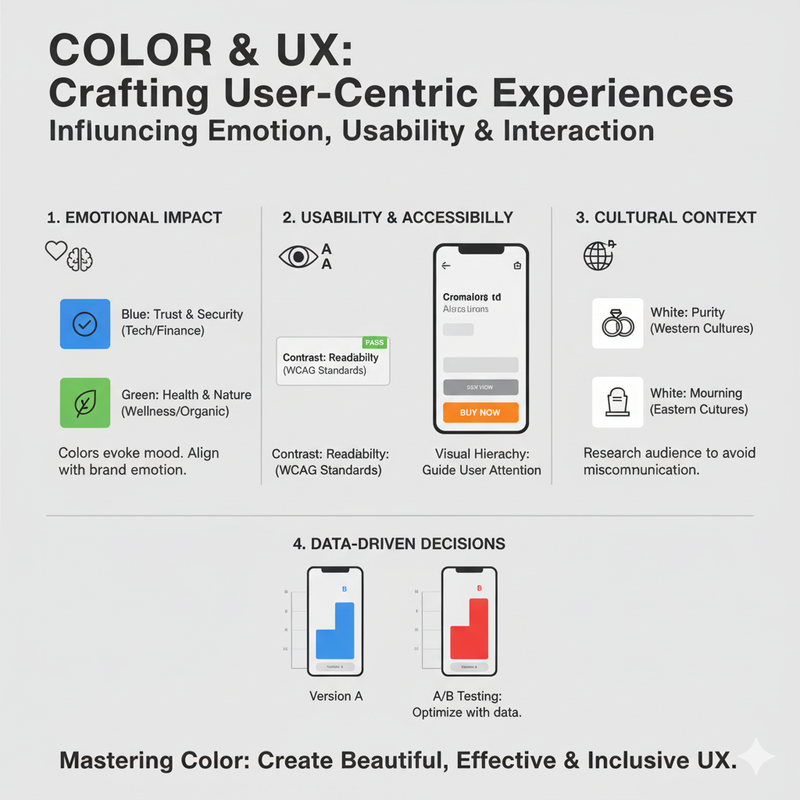
Color choices are critical to UX. Discover how your palette influences user emotion, usability, and interaction, and learn how to make color decisions that improve your product. User experience (UX) is all about how a user feels when interacting with a product. Color plays a huge role in shaping this experience. The right color palette can make a user feel happy, calm, or excited. The wrong one can make them feel confused, anxious, or frustrated. Color can affect usability in many ways. For example, the contrast between text and background colors is crucial for readability. If the contrast is too low, users may struggle to read the text, which can lead to a frustrating experience. This is especially important for users with visual impairments. The WCAG (Web Content Accessibility Guidelines) provide specific recommendations for color contrast to ensure that websites are accessible to everyone. Color can also be used to create a clear visual hierarchy. By using different colors for different types of elements, you can guide the user's eye and make the interface more intuitive. For example, you could use a bright, bold color for your primary call-to-action buttons to make them stand out. You could use a more muted color for secondary buttons. This helps the user understand the importance of different elements and make decisions more easily. The emotional impact of color is also a key part of UX. Different colors can evoke different emotions. For example, blue is often associated with trust and security, which is why it's a popular choice for financial and tech companies. Green is often associated with nature and health, which is why it's a popular choice for wellness and organic brands. By choosing colors that align with the desired emotional response, you can create a more engaging and memorable experience for your users. Cultural differences in color perception are also important to consider. A color that is positive in one culture may be negative in another. For example, white is associated with purity in many Western cultures, but with mourning in many Eastern cultures. It's important to research your target audience and understand their cultural background to avoid sending the wrong message. A/B testing can be a valuable tool for understanding the impact of color on user behavior. By creating two versions of a design with different color palettes and showing them to different groups of users, you can see which one performs better. This can help you make data-driven decisions about your color choices and optimize your design for the best possible user experience. In conclusion, color is a powerful tool that can have a huge impact on user experience. By understanding the principles of color theory, color psychology, and accessibility, you can create designs that are not only beautiful but also effective, user-friendly, and inclusive.