
How to Use Accent Colors to Highlight Key Elements
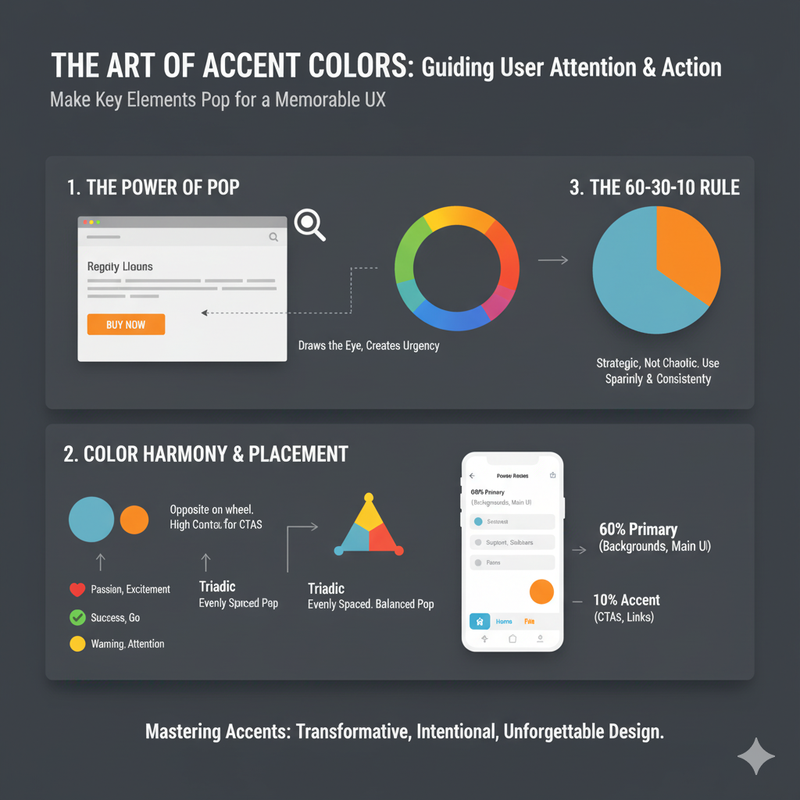
An accent color can make or break a design. Learn the art of using a pop of color to guide user attention, highlight calls-to-action, and create a memorable user experience. Accent colors are used sparingly to emphasize certain elements. They are typically bright, vibrant, and contrast with the primary colors of the design. The purpose of an accent color is to draw the user's eye to important elements, such as buttons, links, or important information. When choosing an accent color, it's important to consider the overall color scheme of your design. The accent color should complement the primary colors and create a sense of harmony. A good way to choose an accent color is to use a color wheel. Complementary colors, which are opposite each other on the color wheel, are a great choice for accent colors because they create high contrast. For example, if your primary color is blue, you could use orange as an accent color. Another approach is to use a triadic color scheme, which uses three colors that are evenly spaced on the color wheel. One of the colors can be used as the primary color, while the other two can be used as accent colors. It's also important to consider the psychological impact of the accent color. Different colors can evoke different emotions. For example, red is often associated with urgency and importance, which makes it a good choice for calls-to-action like 'Buy Now' buttons. Green is often associated with success and confirmation, which makes it a good choice for success messages. Yellow is often associated with warnings and attention, which makes it a good choice for highlighting important information. The placement of the accent color is also important. It should be used strategically to guide the user's eye through the design. For example, you could use the accent color for all of your call-to-action buttons to create a clear and consistent visual language. You could also use it to highlight important headings or links. The key is to use the accent color sparingly and consistently. Overusing an accent color can make a design feel cluttered and chaotic. A good rule of thumb is the 60-30-10 rule, where 60% of the design is the primary color, 30% is the secondary color, and 10% is the accent color. By following these principles, you can use accent colors to create designs that are not only beautiful but also effective and user-friendly.