
Color Harmony Explained: Analogous, Complementary, and Triadic
Color harmony is the art and science of combining colors in a way that is pleasing to the eye. When colors are used harmoniously, they create a sense of order and visual satisfaction. When they are not, the result can be chaotic or jarring. Understanding the fundamental principles of color harmony, which are derived from the geometric relationships between colors on the color wheel, can elevate your designs from good to great. These principles are not strict rules, but rather time-tested guidelines that provide a starting point for creating beautiful and effective color palettes.
The color wheel, first developed by Sir Isaac Newton, is the foundation of all color harmony. By understanding the relationships between colors on the wheel, we can create palettes that are scientifically proven to work well together. Let's dive into three of the most fundamental types of color harmony:
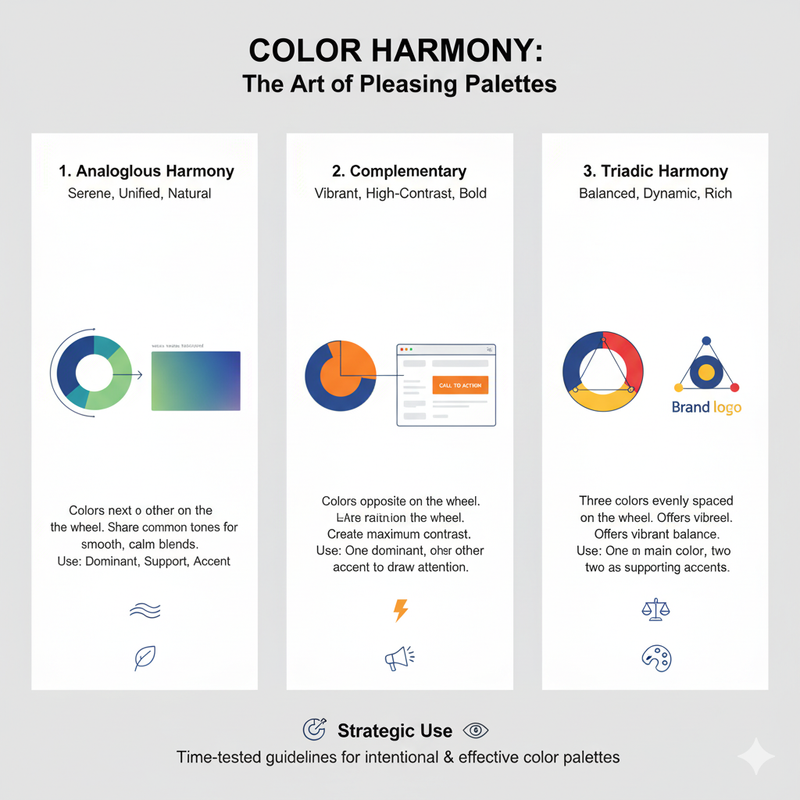
- Analogous Harmony: This is one of the simplest and most foolproof methods for creating a harmonious palette. An analogous scheme uses colors that are located directly next to each other on the color wheel, such as blue, blue-green, and green. Because these colors share common underlying tones, they blend together seamlessly and create a serene, comfortable design. These palettes are often found in nature and are inherently low in contrast, making them ideal for creating a calm and sophisticated atmosphere. When using this scheme, it's best to choose one color to be dominant, a second to be supporting, and a third as an accent.
- Complementary Harmony: This scheme is built on a foundation of high contrast and energy. It uses two colors that are directly opposite each other on the color wheel, such as red and green, or blue and orange. The extreme contrast is perfect for drawing attention to specific elements and creating a vibrant, dynamic design. When you place two complementary colors side-by-side, they make each other appear brighter. However, this can also be visually jarring if not handled with care. The key is to let one color dominate and use its complement as a targeted accent. For example, a website with a predominantly blue background could use pops of orange for its call-to-action buttons.
- Triadic Harmony: This scheme offers a fantastic balance of vibrancy and stability. It uses three colors that are evenly spaced around the color wheel, forming an equilateral triangle. The most classic example is the primary triadic palette: red, yellow, and blue. A triadic harmony provides strong visual contrast while retaining a sense of balance and color richness. This versatility makes triadic palettes a popular choice for a wide range of designs. As with complementary schemes, it's wise to let one of the three colors be the star of the show and use the other two as supporting accents to avoid overwhelming the viewer.
Beyond these three harmonies, there are several other useful schemes. A **Split-Complementary** scheme is a variation of the complementary scheme that uses a base color and the two colors adjacent to its complement, creating high contrast with less tension. A **Tetradic (or Rectangle)** harmony uses four colors arranged into two complementary pairs, offering many combinations but requiring careful balance.
Knowing these rules empowers you to make intentional and effective color choices, moving beyond random selection to a more strategic approach. These harmonies provide a solid foundation for any design. You can start with one of these classic schemes in our Palette Creator to build a balanced and professional palette, confident that your color choices are grounded in the timeless principles of color theory.